
Brain Exercise Initiative is a 501(c)(3) nonprofit focused on preventing memory loss through brain exercise.
Organization Description:
Nonprofit organization’s mission statement and methods of accomplishing their goals
BEI, Brain Exercise Initiative, is a 501(c)(3) nonprofit focused on preventing memory loss through brain exercise. Its founder is UCLA student Esin Gumustekin. She first became fascinated with Alzheimer’s Disease while interning at Samumed, a San Diego based biotech company focused on developing medicine for a wide range of diseases including osteoarthritis, cancer and Alzheimer’s Disease using the Wnt pathway. After conducting research on the Alzheimer’s drug SM07883, Esin became interested in researching other potential therapeutics to combat this debilitating disease. In the course of researching, Esin came upon the captivating research done in Japan regarding the power of math exercises and reading aloud on Alzheimer’s patients. Pioneered by neuroscientist Dr. Ryuta Kawashima, it has been found that doing simple math and reading aloud for just 30 minutes a day, 5 times a week, caused marked improvements for those with Alzheimer’s. Most showed improvements in cognitive function as tested by Mini Mental State Examinations (MMSE) and Frontal Assessment Batteries (FAB). Many began to feel happier and improvements in communication and cognition were recorded. This is when BEI came into existence. BEI’s mission is to help seniors with Alzheimer’s improve cognitive function, and the way they accomplish this is through a mobile app for providing seniors with simple math, reading, and writing exercises.
Name of Nonprofit:
Brain Exercise Initiative (BEI)
Website:
https://www.brainexerciseinitiative.com/
Mission:
Help seniors with Alzheimer’s Disease improve cognitive function
Problem Overview:
Briefly describes the issue that the nonprofit is experiencing and needs assistance with
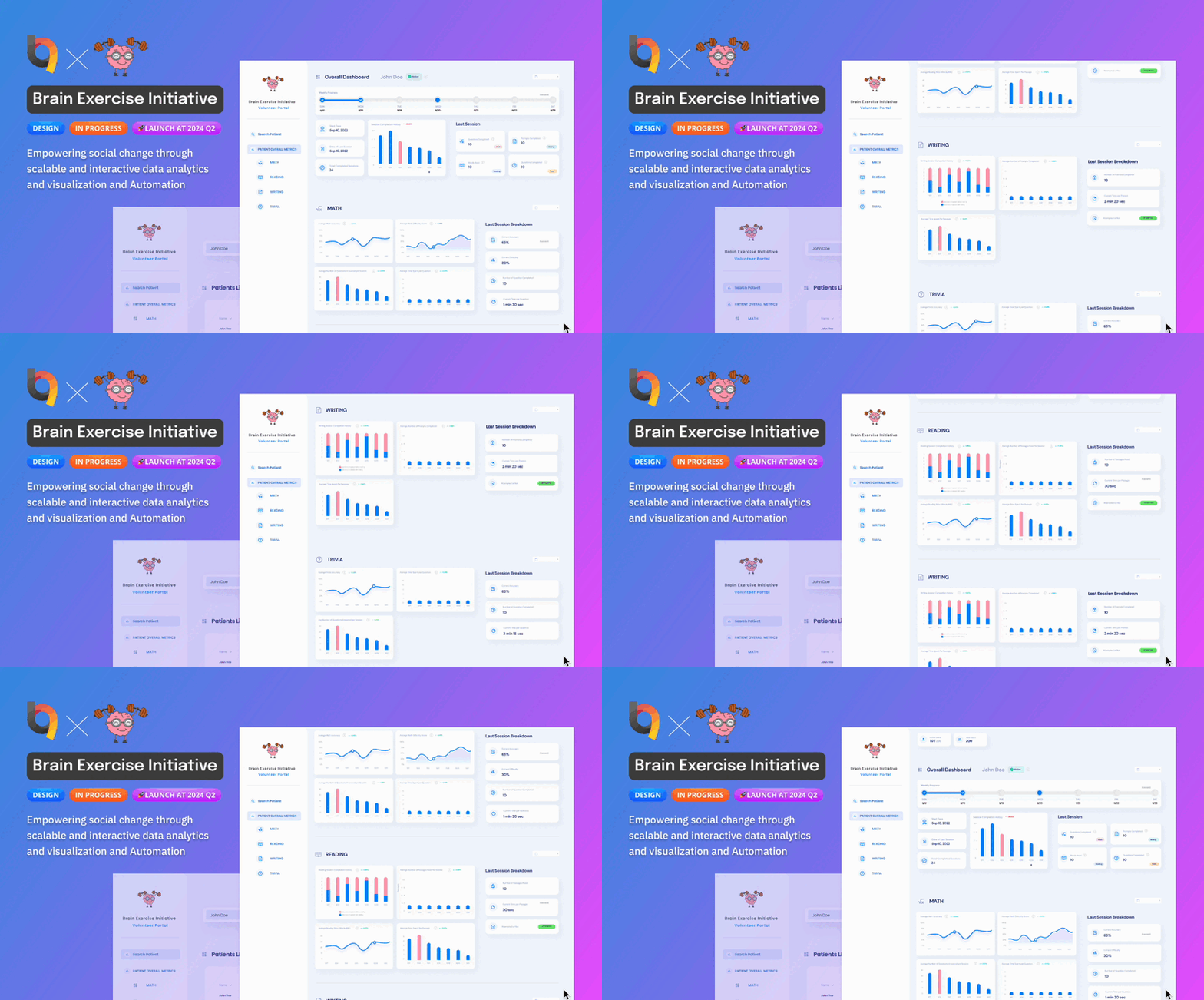
Brain Exercise Initiative has asked for analytics reporting to be visible to the administrative side of their organization in order to understand how mobile app usage affects Alzheimers’ progression. As the app is one portion of a multi-faceted approach they use to help slow the progression of the disease in the seniors they work with, having detailed usage data will improve their ability to help on an individual and organization-wide scale. By enabling backend analytics, the process of monitoring patient progress and participation becomes seamless for the BEI team. Brain Exercise Initiative have also asked for additional features that allow users to schedule video conferences with neurologists/BEI users, use an auditory-based exercise in the mobile app, increase difficulty of questions based on number of correct answers, and refer seniors with Alzheimer’s to the application from non-urban areas. Furthermore, the main statistics that are important to monitor are app usage and question difficulty—Tim stated that they prefer the analytics hub to be set in place so that adding different metrics to the analytics hub would be seamless for the future.
Current Process:
The current process that the nonprofit organization uses and how it may be contributing to the problem
Currently, BEI relies on the user using the mobile app consistently for about 30 minutes each session (5 sessions in a day) to get meaningful data which is not available in a centralized location. Therefore, BEI has no way of obtaining this useful backend analytics, which can be beneficial for helping with modifications for the mobile app in the future and adding new features to the app if needed. Since the mobile app itself is relatively new, BEI also wants to expand upon its capabilities, which is another goal of the project.
Vision/Goal:
Please describe what the project is about overall and the final goal you have in mind. Please provide quantitative results, ex. “Increase volunteer engagement by 50%”
The goal of this project is to develop analytics reporting in the backend for BEI to monitor user progress. When speaking with Tim, he stated that the primary goal is to finish the backend analytics hub, while the secondary goals include adding video conferencing for BEI app users, adding a referral system so Alzheimer’s patients far from large cities can be referred to the BEI app, adding difficulty progression for questions in the app, and adding an auditory feature along with the other exercises in the app.
More Details:
Any extra details about the project that the team should know. Ex. There’s a team already working on it.
The PMT has been keeping in touch with BEI for the past couple of months, and I have recently transitioned into the main point of communication with BEI as the NPP point of contact. It was decided that this project could be a whole project itself rather than simple maintenance to the app since there are new features and a whole new backend analytics system.
Are they a 501(c)(3)?
Yes
Any reviews or comments on Google, Facebook, or other social media? (do a Google search on them)
So far, the BEI app has 22 ratings, with 5.0/5.0 stars. BEI is a legitimate organization that is determined to help seniors with Alzheimer’s Disease.
Will we be dealing with any user data? Is this data sensitive?
In this project of creating a backend analytics hub and adding the additional app features of video conferencing/referral of patients to the application, we will not be dealing with the user data. I spoke with Tim, and he directly told me not to worry about any data privacy issues as our organization will not deal with the user data directly.
(if building off of an existing application) Does the nonprofit have ownership over their own code? If not, who owns their codebase?
The BEI application was developed by Hack4Impact, and thus the codebase is easily accessible.
How large is the nonprofit? (Number of employees, full-time or part-time, number of chapters/locations)
Brain Exercise Initiative has over 4,000 volunteer members, 70 chapter presidents, and is present in 4 countries and all 50 states (including every major d1 university and most major cities in the U.S).

How Bits of Good Can Help
These should be written once the above points are answered by the nonprofit to pitch to them upon meeting:
Project Overview:
Bits of Good can develop the backend analytics hub for BEI as well as add the new features described in the engineering section of this product proposal.
Proposal:
More in-depth description of how Bits of Good can approach the problem and potential issues and benefits associated with each approach
BoG can approach this problem engineering-wise by prioritizing the development of the backend analytics hub first and then focusing on the additional features to the application. The benefit of this prioritization is helping the staff of BEI quickly meaningful data for users who currently use the application. However, this approach does push off the implementation of the new features into the application – Tim made it clear that the backend analytics hub is the top priority, with the new features as an add-on once the analytics hub is set in place.
•
Priorities for Feature Implementation:
#1 Difficulty
#2 Referral
#3 Auditory
#4 Scheduling/Video Conferencing
User Group:
The main users of the backend application are the BEI staff who will be monitoring the progress of the seniors who use the app. The beneficiaries of the new features to the app would be the seniors that have Alzheimer’s Disease who use the application.
Main Engineering Components
Main engineering components (short bulleted list)
•
Engineering: Build out backend webpage with data analytics presented for administrators and volunteers to visualize and track seniors’ performance and app usage
•
Engineering: Integrate aforementioned performance statistics with progressive overload question difficulty, determine a way to scale questions to current performance as well as global performance on an individual question
1. Questions could be ranked in terms of global difficulty (% correct)
2. Then only present questions to a user that are within a certain difficulty window
3. Work toward progressively harder questions each day or week
•
Engineering: Implement auditory feature:
◦
Question Posed for Tim: For the proposed auditory feature, would you want it to be so that the user of the application speaks into the application through the phone's microphone, or would it be so that the application speaks to the user, and the user performs an action based on what the application says audibly (for instance, the application says a word out loud and the user types the word back into the application)?
▪
Answer Given: Ideally having an option for both. Talking “reading out loud” to the app for the reading section. And having a voice speaking and having the app highlight the words being spoken during other sections like trivia. This is the most scientifically relevant way to activate the neural circuits that degrade during AD.
•
Potential Feature - Engineering: Implement video conferencing/scheduling feature for patients to talk to others(other BEI patients, BEI staff members, neurologists, etc.)
•
Engineering: Implement a feature to capture Alzheimer’s patients in non-urban areas to get referred to the app and participate
Main Design Components
Main design components (short bulleted list)
Design: Create backend hub designs (how can we visualize & display relevant statistics in a user-friendly way?)
•
main statistics are app usage, question difficulty, etc.
Design: User research to understand how to continuously engage users and diminish app abandonment
Design: How to effectively pair users with others in a customized video conference setting